
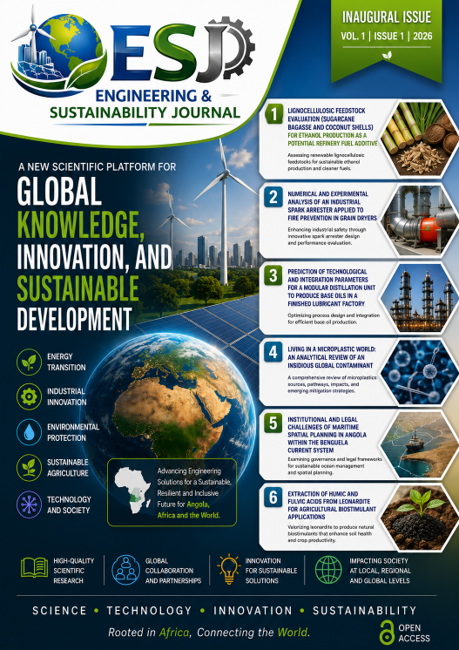
Extraction of humic and fulvic acids from leonardite for agricultural biostimulant applications
Keywords:
Biostimulants, Leonardite, Humic substances, Humic acids, Fulvic acids, Sustainable agricultureAbstract
Biostimulants have emerged as a promising strategy to support sustainable growth in global agribusiness. Brazil, as one of the world’s leading agricultural producers, increasingly demands efficient and sustainable alternatives to enhance productivity. Among biostimulants, humic substances stand out due to their positive effects on soil properties and plant development. These compounds can be obtained from different mineral sources, and their origin influences their composition and effectiveness. Leonardite is recognized as one of the richest natural sources of humic substances and is widely used to produce agricultural biostimulants. In this study, the extraction of humic and fulvic acids from leonardite sourced was investigated, motivated by growing industrial interest in this material. The study included physicochemical characterization of the raw material and optimization of extraction conditions. A simplified sequential extraction approach was evaluated to investigate how operational parameters influence the selective recovery of humic substances. A 2² factorial design was applied to evaluate the effects of reagent concentration and extraction time. For fulvic acid extraction, the highest concentration (160.0 mg L⁻¹) was obtained at high acid concentration and short extraction time (30 min). For humic acid extraction, the maximum concentration (255.6 mg L⁻¹) was achieved under alkaline conditions after 3 h of extraction. FTIR analysis confirmed the presence of characteristic functional groups of humic substances in both the raw material and the extracted fractions. The results demonstrate that humic substances can be efficiently extracted under controlled conditions using a simple process. The short extraction times and operational simplicity highlight the potential for scale-up and industrial application, particularly in the production of agricultural biostimulants. Furthermore, the study contributes to the understanding of how extraction conditions influence the selective recovery of humic and fulvic fractions from leonardite.
References
Allahkarami, E., Allahkarami, E., Rezai, B., & Azadmehr, A. (2025). Advancing humic acids extraction procedures: A review of methods, innovations, and sustainability challenges. Separation and Purification Technology, 376, 133954. https://doi.org/10.1016/j.seppur.2025.133954
Barzgar, Z., Towfighi, H., Fathi-Gerdelidani, A., Shahbazi, K., Heidari, A., Etesami, H., Verrillo, M., Savy, D., & Spaccini, R. (2025). Molecular determinants of humic and fulvic acids in enhancing micronutrient availability in calcareous soils: a comparative study on Fe, Mn, Zn, and Cu dynamics. Scientific Reports, 15, 34142. doi: 10.1038/s41598-025-06678-3
Canellas, L. P., Olivares, F. L., Aguiar, N. O., Jones, D. L., Nebbioso, A., Mazzei, P., & Piccolo, A. (2015). Humic and fulvic acids as biostimulants in horticulture. Scientia Horticulturae, 196, 15-27. https://doi.org/10.1016/j.scienta.2015.09.013
Csicsor, A., & Tombácz, E. (2022). Screening of humic substances extracted from leonardite for free radical scavenging activity using DPPH method. Molecules, 27, 6334. https://doi.org/10.3390/molecules27196334
Du Jardin, P. (2015). Plant biostimulants: Definition, concept, main categories and regulation. Scientia Horticulturae, 196, 3-14. https://doi.org/10.1016/j.scienta.2015.09.021
Ibraevaa, Z. E., Kholiya, F., Kabdrakhmanova, A., Gaipbergenova, A. K., Kabdrakhmanova, S. K., Shaimardan, E., Davydova, V. V., & Maussumbayeva, A. M. (2026). Natural biostimulants for sustainable agriculture: the mechanisms and functions of humic substances for plant growth advancement. ACS Omega Article ASAP. https://doi.org/10.1021/acsomega.5c11781
Jomhataikool, B., Kuboon, S., Kraithong, W., & Eiad-Ua, A. (2020). Humic substance extraction from leonardite, lignite Mae Mho Mine by base-acid treatment process. Journal of Applied Sciences, 16, 26-32. https://doi.org/10.14416/j.appsci.2017.10.S04
Lima, L. S. M. S., Almeida, R., Quintaes, B. R., Bila, D. M., & Campos, J. C. (2017). Análises de metodologias de quantificação de substâncias húmicas em lixiviados de aterros de resíduos sólidos. Revista Ambiente & Água, 12, 87-98. https://doi.org/10.4136/ambi-agua.1972
Machado, W., Franchini, J. C., Guimarães, M. F., & Filho, J. T. (2019). Spectroscopic characterization of humic and fulvic acids in soil aggregates, Brazil. Heliyon, 6, e04078. https://doi.org/10.1016/j.heliyon.2020.e04078
Maffia, A., Oliva, M., Marra, F., Mallamaci, C., Nardi, S., & Muscolo, A. (2025). Humic substances: bridging ecology and agriculture for a greener future. Agronomy, 15, 410. https://doi.org/10.3390/agronomy15020410
Meng, F., Yuan, G., Wei, J., Bi, D., & Wang, H. (2017). Leonardite-derived humic substances are great adsorbents for cadmium. Environmental Science and Pollution Research, 24, 23006-23014. https://doi.org/10.1007/s11356-017-9947-8
Nardi, S., Schiavon, M., & Francioso, O. (2021). Chemical structure and biological activity of humic substances define their role as plant growth promoters. Molecules, 26, 2256. https://doi.org/10.3390/molecules26082256
Petrov, D., Tunega, D., Gerzabek, M. H., & Oostenbrink, O. (2017). Molecular dynamics simulations of the standard leonardite humic acid: microscopic analysis of the structure and dynamics. Environmental Science & Technology, 51, 5414-5424. https://doi.org/10.1021/acs.est.7b00266
Qian, S., Ding, W., Li, Y., Liu, G., Sun, J., & Ding, Q. (2015). Characterization of humic acids derived from leonardite using a solid-state NMR spectroscopy and effects of humic acids on growth and nutrient uptake of snap bean. Chemical Speciation & Bioavailability, 27, 156-161. https://doi.org/10.1080/09542299.2015.1118361
Reemtsma, T., These, A., Springer, A., & Linscheid, M. (2008). Differences in the molecular composition of fulvic acid size fractions detected by size-exclusion chromatography–on line Fourier transform ion cyclotron resonance (FTICR–) mass spectrometry. Water Research, 42, 63-72. https://doi.org/10.1016/j.watres.2007.06.063
Rosa, C. M. da., Castilhos, R. M. V., Vahl, L. C., Castilhos, D. D., Pinto, L. F. S., Oliveira, E. S., & Leal, O. dos A. (2009). Efeito de substâncias húmicas na cinética de absorção de potássio, crescimento de plantas e concentração de nutrientes em Phaseolus vulgaris L. Revista Brasileira De Ciência Do Solo, 33, 959-967. https://doi.org/10.1590/S0100-06832009000400020
Shah, Z. H., Rehman, H. M., Akhtar, T., Alsamadany, H., Hamooh, B. T., Mujtaba, T., Daur, I., Al Zahrani, Y., Alzahrani, H. A. S., Ali, S., Yang, S. H., & Chung, G. (2018). Humic substances: determining potential molecular regulatory processes in plants. Frontiers in Plant Science, 13 263. https://doi.org/10.3389/fpls.2018.00263
Sheng, G. P., Zhang, M. L., & Yu, H. Q. (2007). A rapid quantitative method for humic substances determination in natural waters. Analytica Chimica Acta, 592, 162-167. https://doi.org/10.1016/j.aca.2007.04.024
Sun, Q., Liu, J., Huo, L., Li, Y. C., Li, X., Xia, L., Zhou, Z., Zhang, M., & Li, B. (2020). Humic acids derived from leonardite to improve enzymatic activities and bioavailability of nutrients in a calcareous soil. International Journal of Agricultural and Biological Engineering, 13, 200-205. https://doi.org/10.25165/j.ijabe.20201303
Volkov, D. S., Rogova, O. B., & Proskurnin, M. A. (2021). Temperature dependences of IR spectra of humic substances of brown coal. Agronomy, 11, 1822. https://doi.org/10.3390/agronomy11091822
Zandonadi, D. B., Monda, H., Gralian, J., James, A., Lamar, R. T., & Santos, M. P. (2025). Humic acids as drivers of plant growth: regulating root development and photobiology through redox modulation. Chemical and Biological Technologies in Agriculture, 12, 71. https://doi.org/10.1186/s40538-025-00789-9
Downloads
Published
Issue
Section
Categories
License
Copyright (c) 2026 Diogo F. Campos, Neli B. de Miranda, Aline G. Gehrke, Vanderleia Botton (Author)

This work is licensed under a Creative Commons Attribution 4.0 International License.
