
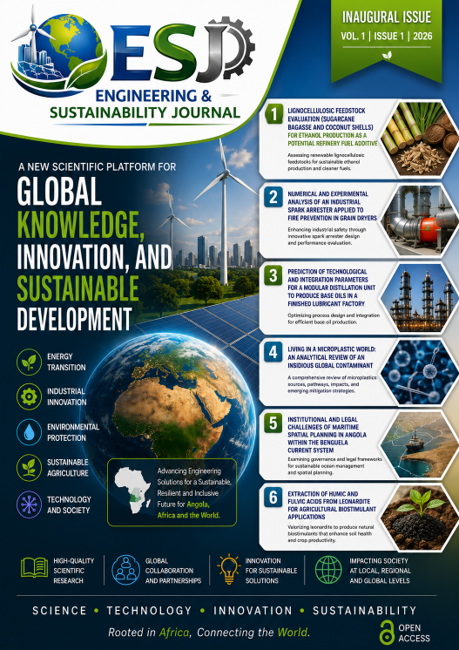
Lignocellulosic feedstock evaluation (sugarcane bagasse and coconut shells) for ethanol production as a potential refinery fuel additive
Keywords:
Potential; Lignocellulosic waste; Sugarcane bagasse; Coconut husks; Refining additivesAbstract
This study evaluated the potential of sugarcane bagasse and coconut shells as feedstocks for producing second-generation ethanol intended as a sustainable oxygenate additive in refinery gasoline. Using a rigorous methodology that included physicochemical characterization of the biomass, acid hydrolysis and fermentation with Saccharomyces cerevisiae, and robust statistical analysis, the results demonstrated the technical feasibility of both residues. Coconut shells stood out for their higher calorific value (16.44 MJ/kg) and significantly higher fermentation yield (90.42%) compared to bagasse (12.6 MJ/kg and 83.20%). Both ethanol products had alcohol contents above 93% v/v, complete combustion with no detectable residues, and, critically, extremely low sulfur content (<0.12%). Statistical analysis using Student's t-test for independent samples (α = 0.05) confirmed a significant difference in fermentation yields between the two biomasses (p = 0.012). However, the low final ethanol titers (≈6 g/L) obtained under the current non-optimized protocol remain a critical bottleneck. It is concluded that while both residues are technically feasible as feedstocks, substantial process optimization, particularly in pretreatment and hydrolysis, is required before their ethanol can be considered for industrial application. The extremely low sulfur content (<0.12%) supports their potential for producing cleaner fuels within a circular economic framework. Recovering these wastes through co-processing in refineries is an effective strategy to promote the circular economy, improve fossil fuel quality (by increasing octane ratings), and contribute to the decarbonization of the transport sector.
References
Aguiar, E. F., & Ximenes, V. L. (2020). Coprocessamento de biomassa: O futuro da indústria de refino de petróleo. RQI, 1(Trimestre), 34–42.
Al-Sahhaf, T., Elkilani, A., & Fahim, M. (2011). Introdução ao refino de petróleo. Elsevier Brasil.
Alvira, P., Tomás-Pejó, E., Ballesteros, M., & Negro, M. J. (2010). Pretreatment technologies for an efficient bioethanol production process based on enzymatic hydrolysis: A review. Bioresource Technology, 101(13), 4851–4861. https://doi.org/10.1016/j.biortech.2009.11.093
Barros, A. A. C., Wiggers, V. R., Muanza e, P., & Cangue, F. R. (2025). Analysis of biodiesel production process using circular economy principles: A review. Brazilian Journal of Chemical Engineering. Advance online publication. https://doi.org/10.1007/s43153-025-00616-6.
Basu, P. (2010). Biomass gasification and pyrolysis: Practical design and theory. Elsevier.
Cabral, M. M. (2015). Aproveitamento da casca de coco verde para a produção de etanol de segunda geração (Dissertação de mestrado). Universidade Federal de Alagoas.
Cardoso, E. A., et al. (2023). Review of lignocellulosic-based biorefineries: Current aspects. Latin American Journal of Energy Research, 10(1), 67–76.
Chen, N., Jiang, K., Zhao, M., Zhang, C., Jin, Y., & Wu, W. (2024). Pretreatment process of lignocellulosic biomass: A review of pseudo-lignin formation. Biomass and Bioenergy, 189, 107352. https://doi.org/10.1016/j.biombioe.2024.107352
Du, Z., Xu, H., Zhang, X., Bao, X., Zhao, J., Li, H., & He, D. (2025). Identifying key factors for optimizing lignocellulosic ethanol production in Saccharomyces cerevisiae through histone modification perturbations. Biomass and Bioenergy, 193, 107584. https://doi.org/10.1016/j.biombioe.2024.107584
Fengel, D., & Wegener, G. (1989). Wood: Chemistry, ultrastructure, reactions. Walter de Gruyter.
Girio, F. M., Fonseca, C., Carvalheiro, F., Duarte, L. C., Marques, S., & Bogel-Łukasik, R. (2010). Hemicelluloses for fuel ethanol: A review. Bioresource Technology, 101(13), 4775–4800. https://doi.org/10.1016/j.biortech.2009.11.088
Hsu, T. A., Ladisch, M. R., & Tsao, G. T. (1980). Alcohol from cellulose. Chemical Technology, 10(5), 315–319.
Hua, T., Li, F., Huang, Y., Shi, Y., & Hao, X. (2024). Rapid fractionation of pseudo-lignin with high yield by chemical and mechanochemical methods. Industrial Crops and Products, 216, 118499. https://doi.org/10.1016/j.indcrop.2024.118499
Jung, Y. H., & Kim, K. H. (2017). Evaluation of the main inhibitors from lignocellulose pretreatment for enzymatic hydrolysis and yeast fermentation. BioResources, 12(4), 9348–9356.
Kim, T. H., Kim, J. S., Sunwoo, C., & Lee, Y. Y. (2010). Pretreatment of corn stover by aqueous ammonia. Bioresource Technology, 101(13), 4872–4878. https://doi.org/10.1016/j.biortech.2009.09.027
Lin, Y., & Tanaka, S. (2010). Ethanol fermentation from biomass resources: Current state and prospects. Applied Microbiology and Biotechnology, 86(3), 801–814. https://doi.org/10.1007/s00253-010-2486-7
Liu, Q., et al. (2025). Unveiling the mechanisms of mixed surfactant synergy in passivating lignin-cellulase interactions during lignocellulosic saccharification. Journal of Colloid and Interface Science, 681, 404–415. https://doi.org/10.1016/j.jcis.2024.08.081
Lora, E. E. S., & Venturini, O. J. (2012). Biocombustíveis. Interciência.
Miller, G. L. (1959). Use of dinitrosalicylic acid reagent for the determination of reducing sugar. Analytical Chemistry, 31(3), 426–428. https://doi.org/10.1021/ac60147a030
Ministério de Minas e Energia. (1982). Balanço energético nacional. Autor.
Morais, P. G., & Cardoso, E. N. Q. (2023). Prospects for autonomy of Angola's transformation industry with growth in oil refining, meeting the challenges of the world energy transition. Angolan Mineral, Oil & Gas Journal, 4(4), 12–19.
Morais, P. G., Cardoso, E. N. Q., Penelas, A. J., & Paim, J. D. S. (2022a). Production of ethanol from Angola grass and subsidies for its industrialization. Angolan Industry and Chemical Engineering Journal, 2(2). https://doi.org/10.47444/aincej.v2i2.16
Morais, P. G., Cardoso, E. N. Q., & Zacarias, L. F. J. M. (2022b). Evaluation of the additive power of ethanol obtained from Angola grass in direct distillation gasoline samples: Case study of straight run (SR) gasoline produced at Luanda refinery. Petroleum & Petrochemical Engineering Journal, 6(2), Article 000304. https://doi.org/10.23880/ppej-16000304
Ortiz, S., Barros, A. A. C., & Furigo Jr., A. (2014). Extraction and quantification of lipids from brewer's spent grain and its potential for lipase production. In Anais do 20º Congresso Brasileiro de Engenharia Química. Florianópolis, Brasil.
Ortiz, S., Simionatto, E. L., & Barros, A. A. C. (2014). Avaliação da capacidade fermentativa e do crescimento celular da levedura Saccharomyces cerevisiae CCT-3174. In Anais do 20º Congresso Brasileiro de Engenharia Química. Florianópolis, Brasil.
Pandey, A. K., Kaur, H., & Gaur, N. A. (2025). Advanced approaches for mitigating impact of pre-treatment generated inhibitors in lignocellulosic hydrolysates: A comprehensive review. Renewable and Sustainable Energy Reviews, 13, 115345.
Phong, H. X., Klanrit, P., Dung, N. T. P., Thanonkeo, S., Yamada, M., & Thanonkeo, P. (2022). High-temperature ethanol fermentation from pineapple waste hydrolysate and gene expression analysis of thermotolerant yeast Saccharomyces cerevisiae. Scientific Reports, 12, 13965. https://doi.org/10.1038/s41598-022-18212-w.
Silva, N. B. M. (2015). Avaliação do bagaço da cana-de-açúcar como matéria-prima para a produção de bioetanol associado a pré-tratamentos químicos e radiação de micro-ondas (Dissertação de mestrado). Instituto Federal Goiano.
Santiago, B. L. S., & Rodrigues, F. A. (2017). Processamento de biomassa lignocelulósica para produção de etanol: Uma revisão. The Journal of Engineering and Exact Sciences, 3(7), 1011–1022. https://doi.org/10.18540/jcecvl3iss7pp1011-1022
Talebnia, F., Karakashev, D., & Angelidaki, I. (2010). Production of bioethanol from wheat straw: An overview on pretreatment, hydrolysis and fermentation. Bioresource Technology, 101(13), 4744–4753. https://doi.org/10.1016/j.biortech.2009.11.080
Teferi, D. A., Kassa, M. G., Belachew, M. T., & Erku, E. G. (2025). Biorefinery and valorization strategies for sugarcane bagasse: Integrating food, health, economic, and industrial applications. Food Science & Nutrition, 13(12), e71262. https://doi.org/10.1002/fsn3.71262
Xu, L., Lou, H., Pang, Y., & Qiu, X. (2025). Low-dosage hydrophobically modified copolymers as effective promoters in enzymatic hydrolysis of lignocellulosic biomass. Bioresource Technology, 437, 133103. https://doi.org/10.1016/j.biortech.2025.133103.
Downloads
Published
Issue
Section
Categories
License
Copyright (c) 2026 Pedro Gelson Morais, Vlademir Pereira, Jacinta Pinto António, Lúcia Rafael Funda, Kavuanda Francisco, Sónia Marinela da Silva Rêgo de Sousa Paim (Author); Elvis Napoleão Queto Cardoso (Translator); Onésimo Sebastião Fula Francisco, Adilson Adilson Venâncio Martins, Samuel Carlos Victorino (Author)

This work is licensed under a Creative Commons Attribution 4.0 International License.
