
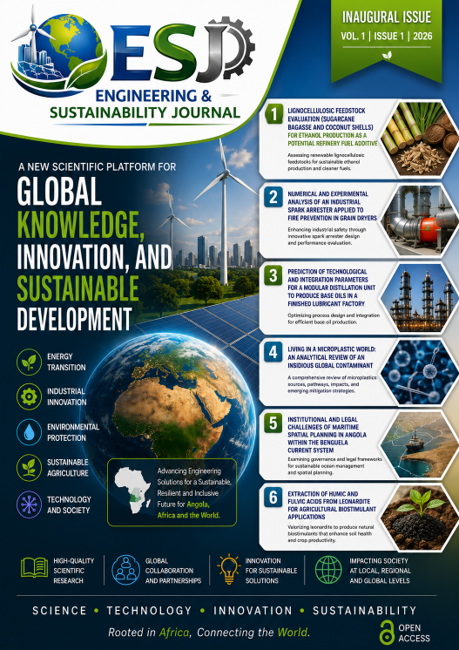
Prediction of technological and integration parameters for a modular distillation unit to produce base oils in a finished lubricant factory
Keywords:
Prediction, Technological parameters, Integration, Modular distillation unit, Base oils, Finished lubricantsAbstract
This research aimed to anticipate technical challenges and integrate an independent vacuum distillation module into a lubricant factory whose existing process relies on purchasing base oils from refineries, adding additives, and blending to produce finished products. The goal was to achieve raw material autonomy by producing its own lubricating oils. The methodological approach was based on: 1) Rigorous identification of process requirements (raw materials, operating conditions, quality objectives, and constraints), according to Smith (2005); 2) Integrated computer simulation in Aspen HYSYS V10 to anticipate bottlenecks and thermal interactions; 3) Consideration of interoperability and control architecture for safe integration; and Economic analysis based on equipment and implementation costs, and return margins. Estimates indicate a column with ten trays, operating temperatures of 169°C (top) and 550°C (base), pressures of 5 kPa and 34 kPa, with the capacity to produce 19,000 tons of base oils per year. The research demonstrates that the insertion of the isolated unit is technically and financially feasible, creating a replicable method to expand the capacity of lubricant factories in similar scenarios.
References
Adeniyi, A. G., Adewoye, L. T., & Ighalo, J. O. (2018). Computer-aided simulation of the pyrolysis of waste lubricating oil using Aspen Hysys. Environmental Research, Engineering and Management, 74(2), 52–57.
API (American Petroleum Institute). (2023). Engine oil licensing and certification system (API 1509). API Publishing.
Bakhtiari, B., & Bedard, S. (2013). Retrofitting heat exchanger networks using a modified network pinch approach. Applied Thermal Engineering, 52(1–2), 973–979. https://doi.org/10.1016/j.applthermaleng.2012.10.045
Dimian, A. C., Bildea, C. S., & Kiss, A. A. (2014). Introduction in process simulation. In Computer aided chemical engineering (pp. 35–71). Elsevier. https://doi.org/10.1016/B978-0-444-62700-1.00002-4
Domingos, V. K. P., Manuel, N., Faria, C. M. M., Cangue, F. R., & Barros, A. A. C. (2024). Numerical simulation of oil refining tower. Studies in Engineering and Exact Sciences, 5(2), e6113.
El-Halwagi, M. M. (2017). Sustainable design through process integration: Fundamentals and applications to industrial pollution prevention, resource conservation, and profitability enhancement. Elsevier.
Filon, D., Anastopoulos, G., & Karonis, D. (2024). Synthesis and evaluation of bio-lubricants from renewable raw materials. Lubricants, 12(12). https://doi.org/10.3390/lubricants12120446
Jechura, J. (2019). Overview to the petroleum refining industry: Process cost estimates. Colorado School of Mines.
Kang, H. S., Lee, J. Y., Choi, S. S., Kim, H., Park, J. H., Son, J. Y., & Noh, S. D. (2016). Smart manufacturing: Past research, present findings, and future directions. International Journal of Precision Engineering and Manufacturing-Green Technology, 3, 111–128. https://doi.org/10.1007/s40684-016-0015-5
Khafaji, H. K., Shahsavand, A., & Rajaee Shooshtari, S. H. (2024). Simultaneous optimization of crude oil refinery vacuum distillation column and corresponding ejector system. Energy, 294, 130702.
Klaus, E. E. (1952). Wear and lubrication characteristics of some mineral oil and synthetic lubricants (Doctoral dissertation). The Pennsylvania State College.
Lee, J., Bagheri, B., & Kao, H.-A. (2015). A cyber-physical systems architecture for Industry 4.0-based manufacturing systems. Manufacturing Letters, 3, 18–23. https://doi.org/10.1016/j.mfglet.2014.12.001
Luanda Refinery. (2010). Manual de operações, monitoramento e manutenções da unidade de destilação a vácuo: Unidade 100. Sonaref.
Mokhtar, S. A. M., & Mosir, M. (2021). Optimising for viability: Revamping vacuum distillation unit in a brownfield project. PLATFORM – A Journal of Science & Technology, Special Edition (ICPEAM 2020), 13–15.
Monostori, L., Kádár, B., Bauernhansl, T., Kondoh, S., Kumara, S., Reinhart, G., Sauer, O., Schuh, G., Sihn, W., & Ueda, K. (2016). Cyber-physical systems in manufacturing. CIRP Annals – Manufacturing Technology, 65(2), 621–641. https://doi.org/10.1016/j.cirp.2016.06.005
Morais, P. G. (2023). Sistema de gestão e monitorização da qualidade de combustíveis e lubrificantes (1st ed.). Generis Publishing.
Morais, P. G., Cardoso, E. N. Q., & Silva, E. B. (2022). Prediction of viscosity behavior of lubricants with temperature variation and its influence on the thermodynamic parameters of Ngol MG-40 oil. Research Article, 3(2), 1–7.
Morais, P. G., & Kurtz, D. J. (2021). Desenvolvimento de um sistema de gestão e monitoramento da qualidade dos óleos lubrificantes automotivos aplicáveis ao contexto angolano. Project, Design and Management, 3(2), 99–116.
Ngoma, M., & Barros, A. A. C. (2023). Production of light naphtha by flash distillation of crude oil. Cognitive Sustainability, 2(4), 10–19.
Petrobras. (2024). Óleos básicos lubrificantes: Informações técnicas (Technical manual). Petrobras Assistência Técnica.
Rudnick, L. R., & Bartz, W. J. (2020). Comparison of synthetic, mineral oil, and bio-based lubricant fluids. In L. R. Rudnick (Ed.), Synthetic, mineral oil, and bio-based lubricant fluids (pp. 1–20). CRC Press.
Simão, J. S. D., Emmanuel, L., João, A. A., Manuel, E. J. L., Nzinga, E. J., Cangue, F. R., & Barros, A. A. C. (2024). Analysis of the thermodynamic behavior of gaseous mixtures using equations of state. South African Journal of Chemical Engineering, 49, 339–347. https://doi.org/10.1016/j.sajce.2024.06.015
Smith, R. (2005). Chemical process design and integration. John Wiley & Sons.
Soares, C., Noriler, D., Barros, A. A. C., Meier, H. F., & Wolf-Maciel, M. R. (2001). Numerical simulation of liquid flow on a distillation tray. In Proceedings of the Iberian Latin American Congress on Computational Methods in Engineering and Brazilian Congress on Computational Mechanics. Campinas, Brazil.
Szklo, A. S., Uller, V. C., & Bonfá, M. H. (2012). Fundamentos do refino de petróleo: Tecnologia e economia (4th ed.). Interciência.
Thielmann, E., Cavalcante, R. M., & Young, A. F. (2022). Simulation and economic evaluation of different process alternatives for the fermentation and distillation steps of ethanol production. Energy Conversion and Management, 267, 115792.
Valmet. (2022). Crude and vacuum distillation: Application report. Valmet.
Zhou, K., Che, X., Wei, C., Tang, Z., Yu, H., Wang, D., Wang, J., & Zhang, L. (2024). The molecular modeling, simulation, and design of base oils and additives in lubricating oils: A review. Processes, 12(11), 2407.
Downloads
Published
Issue
Section
Categories
License
Copyright (c) 2026 Pedro Gelson Morais, Jeremias André Pedro, Jamelson Manuel Neto Basílio Cesar (Author); Elvis Napoleão Queto Cardoso (Translator)

This work is licensed under a Creative Commons Attribution 4.0 International License.
